
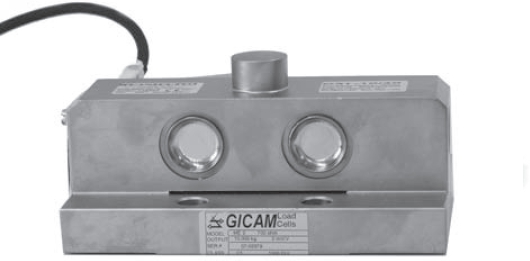
Double shear load cell DT3
Download PDF datasheet
Double shear load cells for balances and scales, tension measure etc.
Double shear load cell
Upon request with ATEX or IECEx certification
C3 OIML Omologated
Click on the image to enlarge
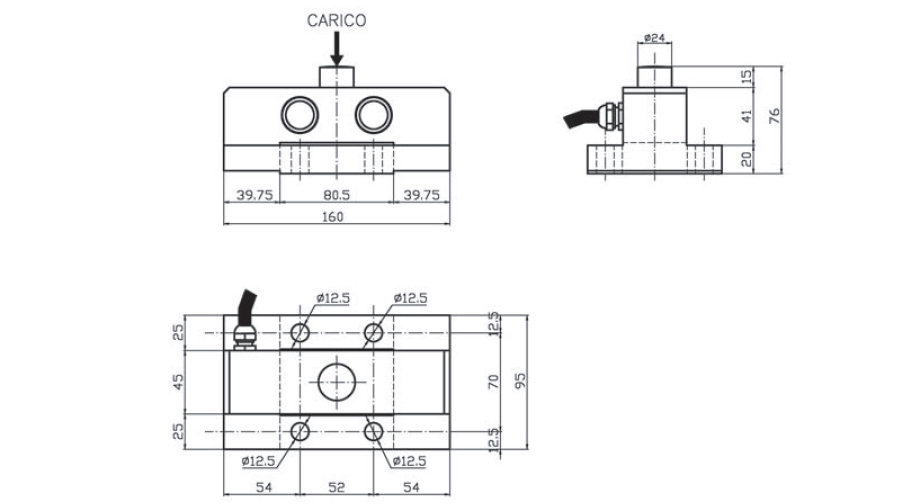



Technical specifications
| Material | Steel |
|---|---|
| Nominal load | 5, 10, 15, 20, 25, 30, 35 t |
| Limit load | 150 % F.S. |
| Breaking load | 300 % F.S. |
| Supply voltage | Maximum 15 V dc |
| Output | 2 mV/V |
| Output tollerance | 0,1 % F.S. |
| Zero tollerance | 1 % F.S. |
| Linearity | 0,03 % F.S. |
| Hysteresis | 0,03 % F.S. |
| Reapeatability | 0,03 % F.S. |
| Input resistance | 700-710 ohm |
| Output resistance | 700-702 ohm |
| Insulation resistance | >= 2000 Mohm |
| Creep (30 Minutes) | 0,03 % F.S. |
| Thermal compensation | -10 / +40°C (14 / +104°F) |
| Operating temperature | -20 / +70°C (-4 / +158°F) |
| Temperature deviation zero | 0,003 % F.S. / °C |
| Temperature deviation full scale | 0,002 % F.S. / °C |
| Protection class | IP 68 |
| Standard cable length | 16 - 20 m – 6 x 0,30 (shield not connected to the load cell body) |
For complete and up-to-date technical specifications please refer to the datasheet you can download here
Download PDF datasheet Connections
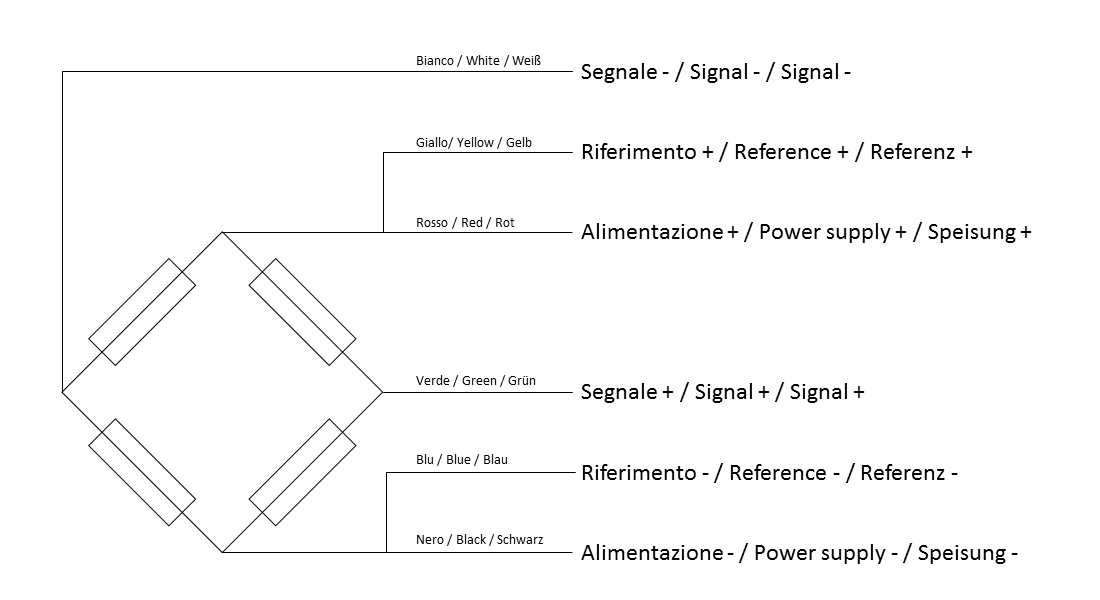
| Type | SHIELDED CABLE 6C R6 PVC 6X0,30 |
|---|---|
| Length | 16 - 20 m (shield not connected to the cell body) |
| Red | + IN |
| Black | - IN |
| Yellow | + REF |
| Blue | - REF |
| Green | + OUT |
| White | - OUT |
Load cell mounting
General guidelines for installing and mounting load cells:
- Respect the direction in which forces are applied to the load cells
- Do not exceed the temperature limits shown on the rating plate
- Do not remove the labels from the cells
- Protect cables properly with sheaths or cable ducts
- Connect each cell to earth with a suitable cable, bridging the plates of the mounting accessories if necessary
- Do not weld on the mechanical structure once the cells are in place
- Avoid or minimise mechanical constraints between the fixed structure and the weighed structure, to prevent weighing errors and zero return problems
- When vibrations or dynamic loads are present, protect the cells with anti-vibration mounts
- Protect the cells from dust build-up with suitable covers